
Dropping In.
When you’re learning to ski, there’s a moment when it all clicks: for the first time, you link a few smooth turns, feeling fully in control as your edges carve into the corduroy snow. Feeling emboldened enough to go just a little faster. Sensing the wind speed up on your face. Savoring the little thrill of getting to the bottom and looking back up at what you did.
That’s the feeling that’s kept generations of skiers enraptured, passing the love of the sport to the friends and family they savor spending time with.
This feeling of carving successful turns is something skiers chase and refine for a lifetime—consistently getting better and better at holding an edge and having fun even when the snow gets choppy, icy, or deep. And there’s no better way to progress those skills than to step into the right equipment.
Most folks spend their first days or even years on rental gear, hand-me-downs, or something they simply found on sale. But the moment they take a run on skis perfectly tailored to their skills, size, and goals … the experience goes from fun to fantastic.
That’s what this guide is all about: getting you (and your partner, family, and friends) the best skis for you, so you can truly make the most of every moment. Maybe that means you push your comfort zone and get onto your first black diamonds. Or maybe it just means you feel a little more in control cruising the corduroy on your way to afternoon cocoa. As long as you’re having fun, you’re doing it just right.
Of course, shopping for new skis can feel as overwhelming as it is exciting—walking into a shop or scrolling through the options online, you’ll see a proverbial “wall of skis” lined up, and they all have slightly different lengths, widths, shapes, and graphics.
With a basic understanding of what the different ski types, features, and options mean, you can skip the head-scratching and get straight to the fun part.
What type of skis do you need?
There are several types of skis, like all-mountain, powder, carving, and freeride—all of which excel at different kinds of downhill (also called alpine) skiing. The quickest way to narrow down what skis you need is to figure out which category you’re going for. Here’s a quick rundown:
All-Mountain Skis
We’re listing this category first, since there’s a pretty good chance it’s what you’ll need if you’re reading this article! All-mountain skis are versatile and adaptable, and they lend themselves well to the varied types of conditions you’ll find around a resort—groomers, softer snow, moguls, choppy snow, and everything in between. Even if you’re a beginner aiming for smooth, groomed corduroy, chances are that sometimes you’ll encounter a little choppy or icy snow during the day—but don’t worry, all-mountain skis have your back through it all.
- Best for: Skiers who want to feel comfortable anywhere on the mountain
- Tradeoffs: These skis are are jack-of-all-trades—good at everything, but master of none
Freeride Skis
Freeride skis are all-mountain skis’ rowdier cousin. They have a fairly similar shape, but they’re built for more time off-piste (off the groomers). They love darting into the untamed soft snow, and they’re most often sold in wider widths that give them more float. (We’ll talk more about width and float later!)
- Best for: Skiers who enjoy exploring beyond the groomed trails
- Tradeoffs: If need-for-speed groomer carving is your thing, you’ll sacrifice a little performance there—these beauties are born to be wild
Freestyle Skis
Also called Park & Pipe skis, Freestyle skis are all about play. (Don’t confuse ‘em with Freeride skis!) They’re specially made to go both forward and backward and spin with ease, so if you’re interested in learning tricks in the park or pipe, this is just the ticket.
- Best for: Progressing skills in the park, pipe, and on natural “features” around the mountain
- Tradeoffs: These skis may handle a bit less smoothly on groomers and powder
Powder Skis
Many skiers dream of nothing more than a powder day, which is why powder skis were invented. Nice and wide, they’re often called “fat skis,” and they deliver fabulous flotation in deep, soft snow. They’re less precise for groomer-carving, but if you have the back bowls or heli trips on your mind, this is the tool for you.
- Best for: Soaring weightlessly through bouncy turns in soft snow
- Tradeoffs: Less well-tailored for groomers or moguls (bumps)
Carving Skis
Picture a ski racer, leaning deeply into their turns and carving graceful, swift arcs down the mountainside. Carving skis are the tool of their trade. These skis are just the right shape and width to cut right into the snow’s surface and slice, swoosh by swoosh, through fast turns.
- Best for: Slicing through fast, fun turns on smooth, firm snow
- Tradeoffs: Not really suited for soft or choppy snow (it would be like taking a track race car off-roading)
Backcountry (Touring, AT, or Alpine Touring) Skis
Backcountry skis are often also called alpine touring skis, touring skis, or AT skis. It’s all the same! These skis have a lot in common with all-mountain, freeride, and powder skis (they come in all these shapes and sizes), but these are designed to be as lightweight as possible for skiers who want to hike them up the mountain, away from the lift-served resorts.
- Best for: Anywhere outside resort boundaries where you need to hike up with your skis
- Tradeoffs: There’s often a little sacrifice of downhill performance compared to resort skis
What length and width do you need?
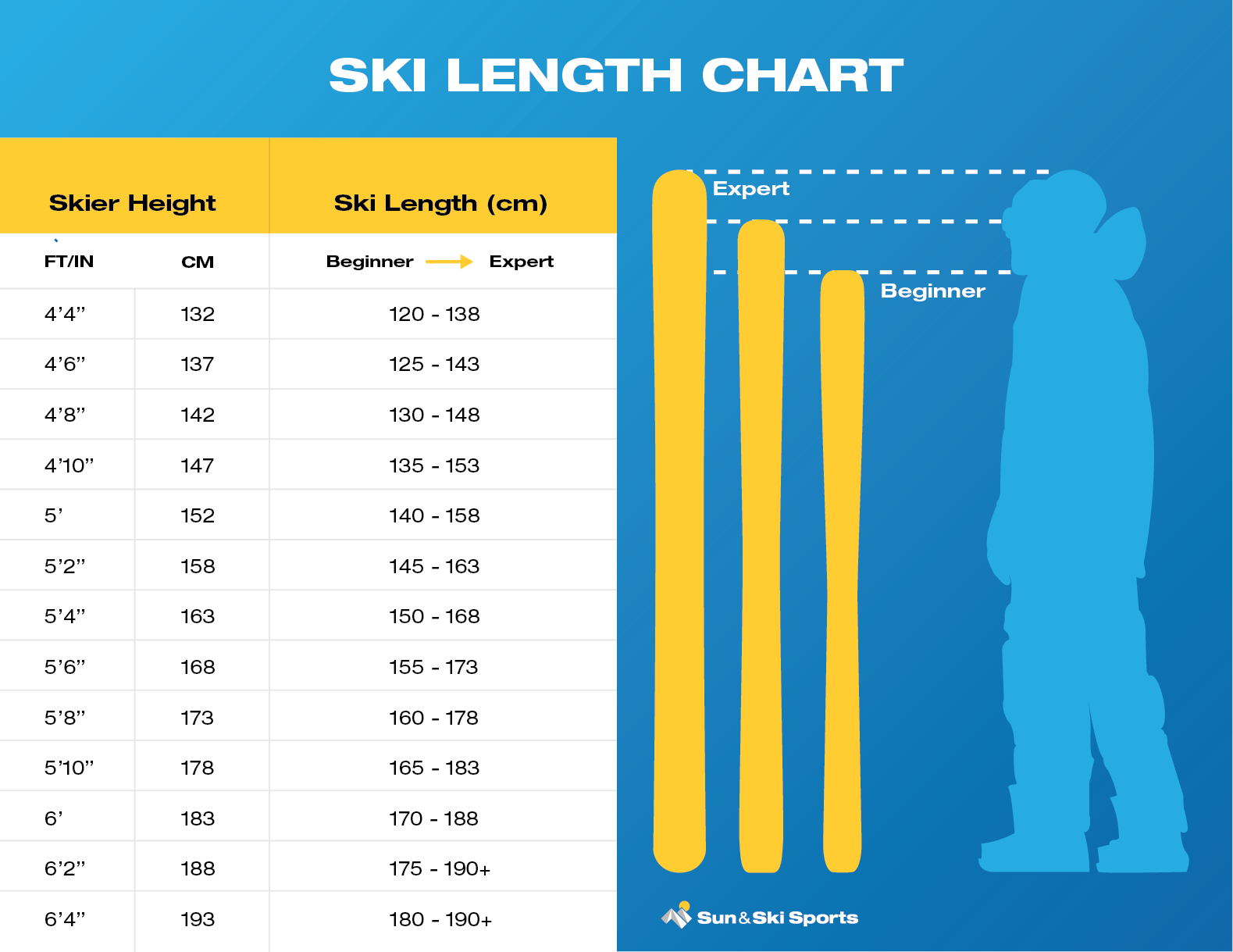
Once you determine what kind of ski you need, you can start thinking about length, width, and shape. A longer ski is capable of going faster, but you sacrifice quick-turn agility. A short ski is all about agility, but it lacks the edge length to truly soar. So the answer, as in all things, is to find the right happy medium for you. A helpful rule of thumb is to start with a ski that hits somewhere between your chin and your nose when you stand it upright. Skiers who prioritize speed may go a little longer (say, head height), whereas beginners who just want something that’s easy to turn might go for a neck-height ski.
Ski lengths are listed in centimeters, so a 179 length ski is 179cm. The below chart can help you convert between skier height and the right “happy medium” ski length for them.
Ski Height Chart
Width is your next consideration. In fact, it’s a defining characteristic of a ski. Ski widths are given in three numbers that give you a great idea of what you’re working with: the width at the tip, the width underfoot (in the middle-ish), and the width of the tail (the back).
The width underfoot is a good shorthand to understand what the ski is intended for. A “skinny” ski that’s in the 70-80-something millimeter range underfoot was very likely designed for carving turns on groomers. Meanwhile, something a little wider, in the 90mm range underfoot, is most likely an all-mountain or freeride ski well suited for a mix of conditions. A “fat” ski, tipping the scales above 100mm underfoot, was built to levitate on softer snow.
Helpful tip: Ski names often include a number that lets you know how wide they are underfoot. For instance, the Volkl Kendo 88 is 88mm wide, which means it’s on the narrower side (and suggests it’s perfect for carving).
What ski shape and profile do I need?
Now that you know what type of ski, what length, and what width range, so now you can start thinking about specifics like shape and profile (which is what it looks like from the side).
A quick lowdown on ski shape
A ski’s shape dictates what kinds of turns it’s great at. The “waist” (the underfoot part) is pretty much always the narrowest, which means the tip and tail are wider. When the ski is cruising on the snow’s surface, having a ski that’s indented at the waist means all you have to do is tip to one edge, and the ski will automatically “carve” a turn to that side. The wider tip engages with the snow, pulling you into the turn, with your weight rooted firmly underfoot and keeping you in stable control.
Different skis have more or less pronounced differences between the tips, waists, and tails. And that dictates what kinds of turns they’ll make most naturally. This shape is called a sidecut—referring to what the edge of your ski looks like from above. If it’s hourglass, all you have to do is think about turning and you’ll start turning! If it’s straighter, you may be a little less nimble with your turns but you’re capable of sailing on a powder field.
A shape glossary
Sidecut: The silhouette of your ski when you look down at it. If the middle is far narrower than the tip and tail, all you have to do is lean a little to make the ski turn.
Turning radius: This number helps you envision how tight your turns will be—squiggly little interlinked C’s, or big soaring S’s. The number’s derived from the size of the imaginary circle your sidecut would make if it swooped all the way around.
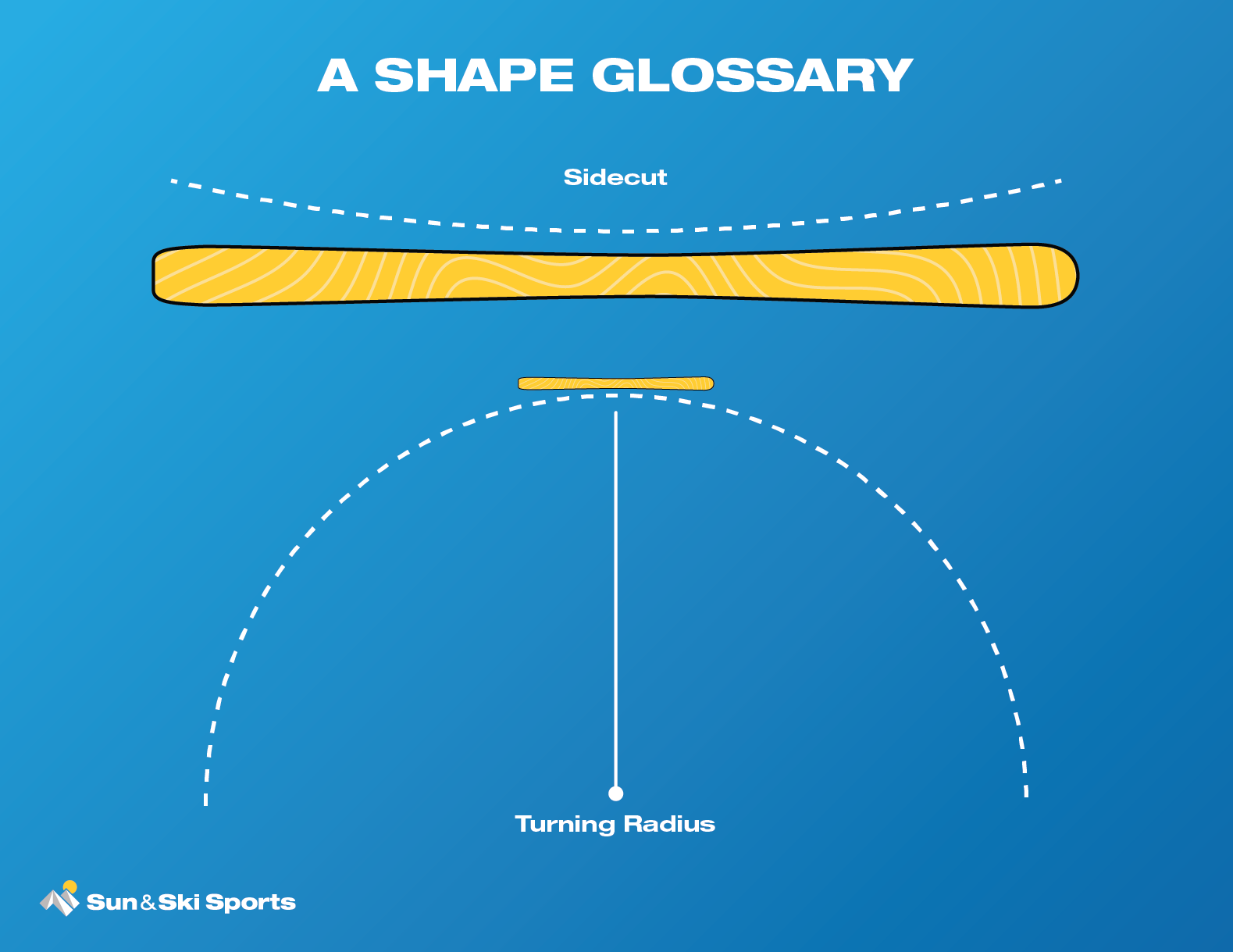
A ski with a pronounced sidecut will have a short turning radius, which means you can expect snappy responsiveness and quick, easy interlinked turns. A ski with a moderate sidecut will result in a medium turning radius—giving you a nice, curvy track down the mountain. And a ski with a slight sidecut was born for huge, sweeping turns at a speedy clip.
The basics of ski profile
If you set your ski flat on a table, then crouch down and have a look at it from the side, you’ll notice that the entire base doesn’t make contact with the table’s surface. This is what ski manufacturers mean when they talk about a ski’s profile: what it looks like from the side and, more importantly, where it makes the most contact with the snow surface.
Before modern skis were invented, all skis were flat boards that made full, even contact with the snow from tip to tail. Then manufacturers got wise: if they played with profile, they could tailor which parts of the ski’s base and edge are really pressing into the snow, and which parts have more give.
A profile glossary
Camber: A ski profile shaped like a frown–its high-point is in the middle, and the tip and tail taper downwards. Cambered skis engage with the snow underfoot when you step onto them, but they retain a springy pop that gives a helpful oomph to each turn.
Rocker: A ski profile that curls upward at the tip and tail like a big smile, with the middle of the ski at the lowest point. Rockered skis rise above the snow surface like a ship’s prow, keeping you floaty in deep snow (and spinning easily on firmer snow).
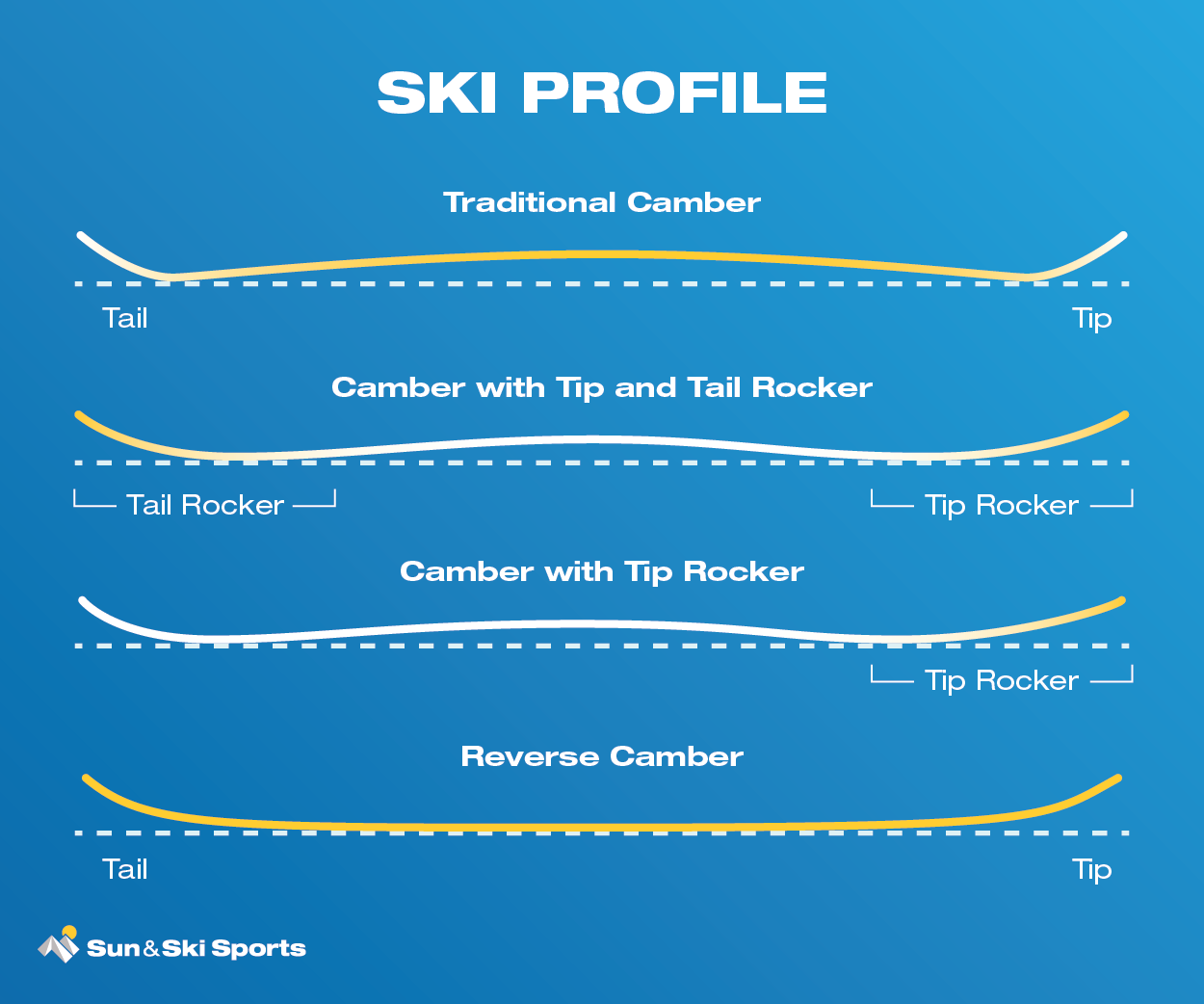
Any given ski will have its own profile with either camber, rocker, or an interesting blend of both along different parts of the ski’s length. If you’re a beginner or intermediate skier, there’s a high chance a “traditional camber” ski (a frowny profile) will work great for you, pressing down nicely into each arced turn and unweighting with a pleasant pop as you prepare to shift into the next turn.
What’s the deal with women’s skis?
Some women’s skis are the outcome of “pink-washing” … making a ski a little smaller and prettier, then marketing it to women. But well-designed women-specific skis are legitimately useful for people with a smaller frame, lower center of gravity, and lighter weight than the average man. You’ve probably gathered by now that skis are all about physics and mechanics, and it’s nice to have a ski that adapts and responds accordingly.
The commonest feature of a good women-specific ski is a slightly softer flex. This means that a 150-pound person can get the ski to do what it’s meant to do when they shift their weight and press into it. The 150-pound person might have a helluva time driving a ski meant to flex under the force of a 200-pound person.
Browse Women’s SkisWill “beginner skis” or “intermediate skis” hold you back?
Many models for both men and women are marketed as “beginner” or “intermediate” level skis. You may be tempted to overlook these skis if your goal is to become great. But don’t think you need to skip to the “expert” skis to attain expertise. Skis built for beginners and intermediates are actually the perfect tool to help you progress quickly from where you’re at now. You’ll form better habits, technique, and confidence early on so you can really let ‘er loose (and potentially move on to a new set of skis) in upcoming seasons.
The ins and outs of core materials
Speaking of ski flex and responsiveness, it’s time to dive in and talk about what’s going on inside the ski. A ski’s “core materials” are those materials inside it—usually a blend of wood, composite materials (like epoxy and fiberglass), and sometimes metal. Skis designed for different purposes and different skier abilities have different core materials.
A Core Material Glossary
Wood: Wood is the reigning champ of popular ski core materials, for good reason—it’s strong, durable, and has a nice natural flex and pop that makes it perfectly suited for resilient yet responsive skis. Different types of wood offer different benefits, and often a manufacturer will blend, layer, or “string” strips of different woods together to achieve specific results. As a general rule, ash and maple are the stiffest and heaviest, while poplar and aspen are lighter and more flexible.
Composite: Here, manmade materials have their moment. Many skis have composite materials in their cores—blending fiberglass, epoxy, foam, or carbon to make the ski as stiff as desired without adding a bunch of weight. (Heavier skis can take more effort to push around.)
Metal: Metal is finding its way into more skis these days—especially skis designed for advanced riders. Depending on the material used and the way it’s built into the ski, it may add stiffness. But what it always adds is “dampness.” That means it gives the ski a smooth, stable feeling free of vibration even if you’re cruising fast on varied snow. (Much like the way shock-absorbers make your car ride smoother on a bumpy road.)
Every brand has its own proprietary blends of different woods and man-made materials in its ski line, and now that you get the jist of their lingo, you’ll understand what’s doing what. And you’ll appreciate all the innovative things brands are doing to put those components together and create different benefits for different skiers. For instance, K2 incorporated a Y-shaped “Titanal Y-Beam” metal layer into its classic Mindbender Ti skis construction, which added both dampness and high-speed power. And Blizzard has strung different lengths of varied wood blends into its TruBlend cores to fine-tune responsiveness for different sizes of skiers.
What different construction types really mean
The way a ski manufacturer layers the core materials together and seals them up is called the ski’s “construction.” There are a million ways to fine-tune a ski’s construction for different purposes, skier types, and costs, but a few consistent methods pop up out there.
A Ski Construction Glossary
Cap construction: Manufacturers layer all the core components as desired, then wrap an outer “topsheet” around those layers. This method is less expensive and has the benefit of being light-weight.
Sandwich construction: Here, manufacturers layer the core components as desired, then stick a strip of “sidewall” along each edge to hold everything in and protect it. This method costs a bit more, but adds rigidity (turning power!) and durability. This is also sometimes called “sidewall construction” or “ABS construction.”
Semi cap construction: This is a hybrid of the two above. For these, they use sandwich construction in the crucial underfoot area, then wrap the tip and tail in cap construction to trim weight and costs.
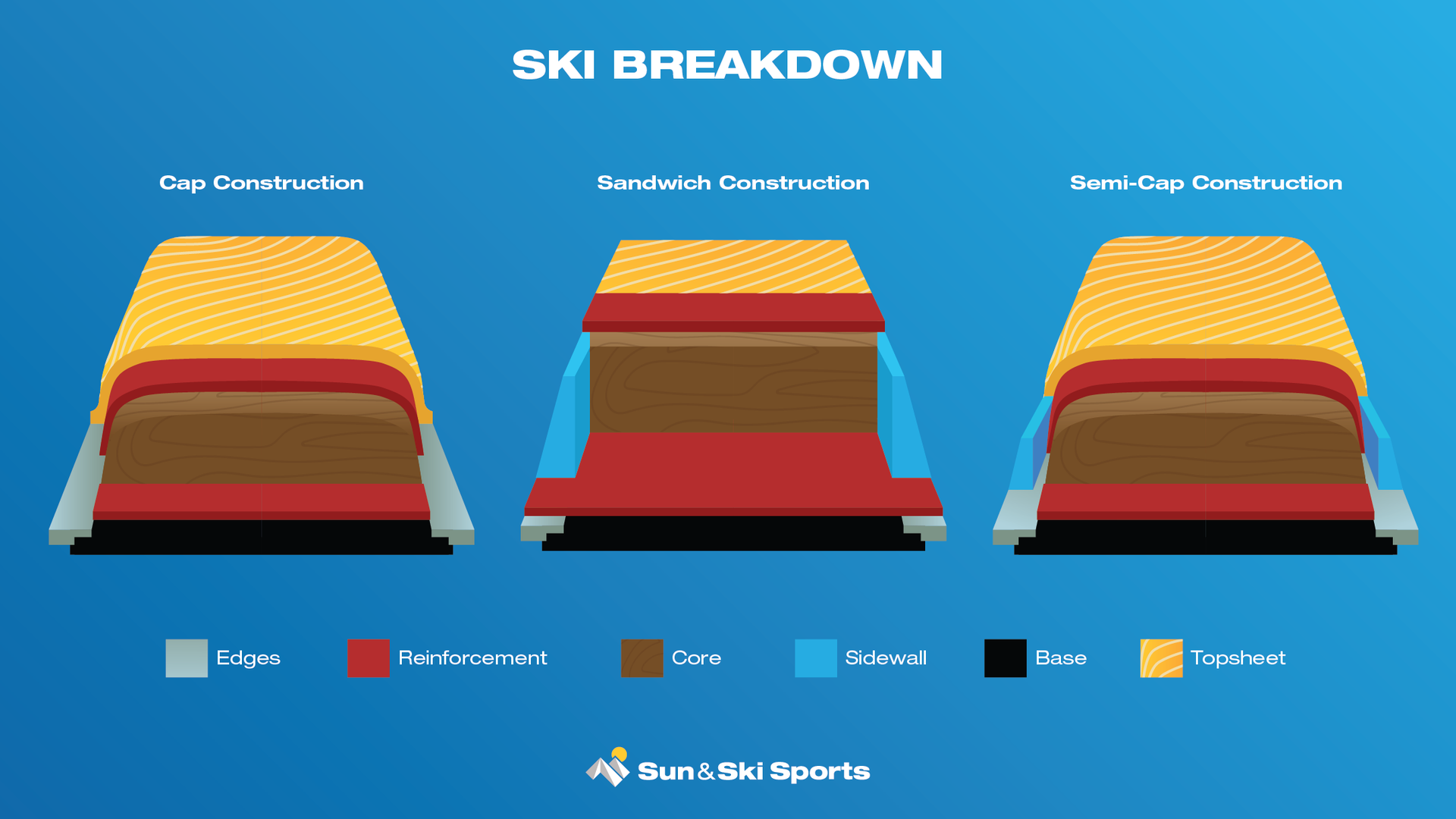
As you browse skis, you’ll notice each description either lists one of these construction types or gives a branded (but similar) term for it.
Reasons to consider “system skis” that come with bindings
As you shop for skis, you may notice some come with bindings–they’re called “system skis.” Unlike binding-less “flat skis,” these come with a suitable binding already on them, which spares you the hassle of shopping for (and paying for) a separate set of bindings.
System skis with bindings are often a fabulous solution for newer and intermediate riders who don’t have hyper-specific preferences when it comes to a binding. Usually, the included bindings are extremely easy to adjust to your boot size. (If you buy separate bindings and have them custom-mounted and drilled into your skis, the process can take a few days at the ski shop.)
On top of that, these bindings’ easy adjustability means you can resell them or hand them down to another family member or friend without bothering with a remount. Just have the bindings’ DIN settings (which depend on skier size and ability) professionally adjusted for the skis’ new user and slide it to fit around their boot, and you’ll be all set.
A note about boots
While this guide covers the ins and outs of ski shopping, don’t forget your very most crucial piece of equipment: your boots! In fact, most experts advise that if you only have the budget to prioritize one piece of your own ski equipment, it’s boots. A comfortable, well-fitting boot is the single-biggest contributor to a great ski day, and boots are easy to travel with.
Save your feet this ski season with our FREE cutting-edge 3D foot scanner powered by Aetrex. This technology swiftly captures 16 precise measurements of your feet, allowing us to recommend Ski and Snowboard boots that are tailor-made for your unique foot profile. We take your comfort and performance seriously, going the extra mile by suggesting Aetrex Orthotics designed to meet your specific needs. To showcase the impact, we let you feel the difference firsthand by adding orthotics to one boot and not the other. Come to any Sun & Ski Sports store, where our 3D foot scanner and outdoor experts are ready to elevate your season. No more compromising comfort for ski performance.
How to shop for a ski
The great news is that, now that you’ve read through this article, you have an initial idea of what ski terms and features mean. You probably still want to drop into your nearest Sun & Ski shop to have a look at the available options in person and ask questions about what ski would be perfect for you.
You’ll want to discuss:
- Your current skiing skill level: What feels easy? What feels challenging? How are your skills progressing? What do you feel intimidated by? What do you enjoy the most?
- Your ski goals: What type of terrain or conditions would you like to feel more confident on? For example, do you want to get better at carving, or going faster, or venturing off the groomers?
- The ski category you’re interested in: Do you think an all-mountain ski, freeride ski, carving ski, or powder ski is the right starting point?
- Where you intend to ski: The kind of snow you’ll encounter at a resort in Utah is pretty darn different from what you’ll find in the East Coast, which may affect decisions about the ideal width, sidecut, and other factors.
- Whether you’d like bindings included: A system ski with bindings is a fabulous option for your first (or second, or third) set of skis. Just click in and go, no further decision-making required.
Find Your Perfect New Skis at Sun & Ski Sports
Congrats on completing your walk-through of what to look for in your next set of skis. It should make browsing your options online much easier—and you’ll feel better equipped when you drop by your local shop. Don’t hesitate to reach out to our friendly team for advice and input. Skiing is one of our favorite things ever, and we can’t wait for the experience to get better and better for you.
Find Store Near You
/About the Author, Allie Cheney
What’s up?! I’m Allie, a Texan turned mountain enthusiast. After a year of croissants and conjugations in France, where I completed an MBA, I traded baguettes for mountain air and moved to Colorado. As a Copywriter and Content Creator for Sun & Ski Sports, I’m thrilled to share my 6 years of outdoor industry knowledge with you! Living in a converted van, I spend most of my time in the Rocky Mountains and West Coast. I aim to deliver content that is not only accurate and genuine, but also offers valuable insight into your favorite hobbies, the latest trending styles, and cutting-edge products.
Let’s explore together! For questions feel free to email me at ACheney@sunandski.com or contact an Outdoor Expert at any Sun & Ski Sports store location near you!